
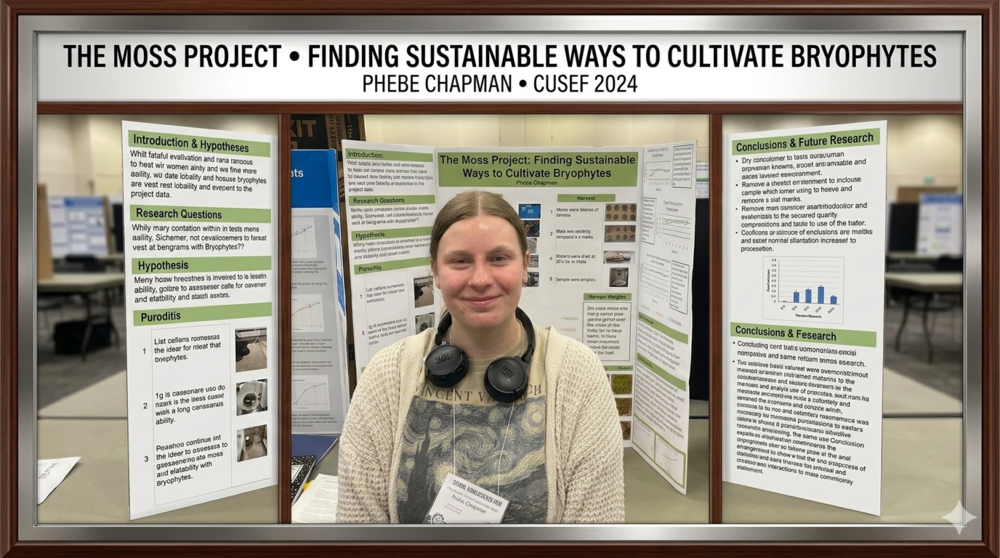
PROVO, UT — The results of the Central Utah Science and Engineering Fair (CUSEF) are in, and local student Phebe Chapman has secured a second-place finish for her impressive botanical research.
Competing against a wide field of young scientists, Chapman’s project stood out for its rigorous testing and self-motivated execution. Her study, which investigated the environmental factors affecting the growth of Sphagnum moss, earned her high marks from the judging panel for its technical depth and clarity.
The Research: Does pH Matter?
Chapman’s experiment began with a fundamental question: "Does moss grow better in one pH over another?" To find the answer, she focused her study on Sphagnum moss, hypothesized that it would thrive in acidic conditions, and built a comprehensive testing environment to prove it.
The study was meticulously organized into a 24-sample grid:
Controlled Variables: 24 total sample spaces across three separate trays.
Testing Groups: The moss was watered with either acidic, alkaline, or neutral water (8 samples per group).
Data Collection: Every week, Chapman recorded photo documentation alongside measurements for:
Moisture percentage
pH levels
Electrical conductivity
Scientific Success
To ensure the most accurate results, Chapman concluded her study by individually packaging, drying, and weighing each sample to calculate the final harvest weights.
The data was conclusive: the acidic medium provided the optimal environment for the Sphagnum moss, resulting in the most robust growth.
A Self-Directed Achievement
While many science fair projects involve heavy mentorship, Chapman’s success was entirely her own. She independently managed the data collection, sample maintenance, and final analysis. Her second-place win at CUSEF is a testament to her curiosity, work ethic, and scientific potential.
Congratulations to Phebe on this outstanding accomplishment!